Reading a natal chart means looking at the sky as it stood at the moment you were born, and finding yourself in it. It looks complicated at first — a circle, twelve slices, ten symbols, a web of lines across the middle. It isn't. Underneath the symbols there are only four questions, asked over and over, and once you know them you can read any chart in the world, including your own.
This guide walks you through those four questions in the order an astrologer actually asks them. You don't need to memorize anything. You need your birth date, your birth time and your birth place, and about twenty minutes.
A chart is not a description of who you are. It is a description of what you are working with.
What is a natal chart?
A natal chart — also called a birth chart; the two words mean the same thing — is a diagram of where the planets were, from where you were, at the moment you arrived.
Stand outside tonight and the sky forms a dome over you. Half of it is above the horizon, half below. The Sun, the Moon and the planets all travel along one narrow band across that dome, and the twelve signs of the zodiac divide the band into twelve equal stretches. A natal chart flattens that dome onto a page and marks where everything stood.
That is why the time and the place matter as much as the date. Everyone born on your birthday shares your Sun sign. Almost nobody shares your exact chart, because four minutes later the whole dome has turned, and the chart turns with it.
The circle you'll see has an outer ring of signs, an inner ring of twelve numbered houses, the planet symbols placed around it, and lines drawn between planets that stand at meaningful angles. Four things. That's the whole vocabulary.
How is the chart wheel laid out?
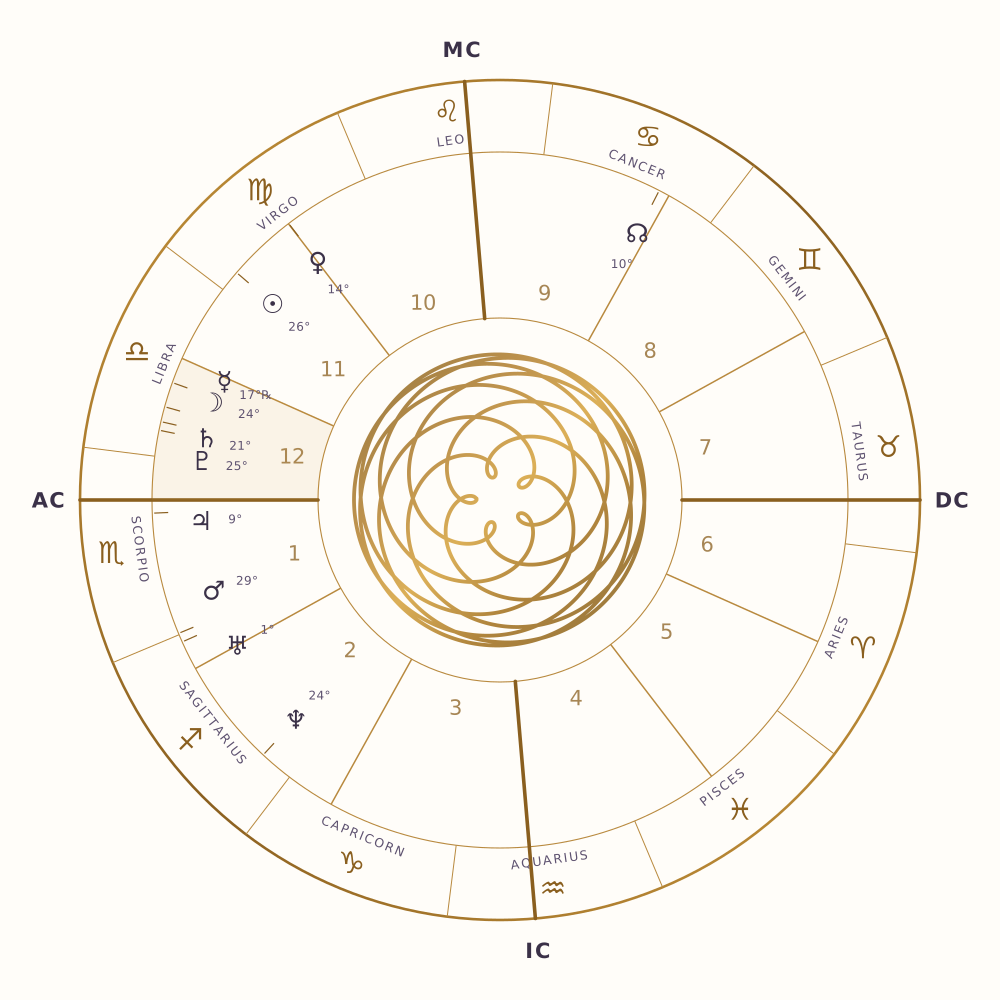
Once you can find four things on it, the rest stops being decoration.
The horizontal line across the middle is the horizon. Everything drawn above it was in the sky above you when you were born. Everything below it was beneath your feet, on the far side of the earth.
Your rising sign sits on the left, at nine o'clock. On the chart it is marked AC or ASC, short for ascendant — rising sign and ascendant are two names for the same thing, and you will meet both. This is the degree that was climbing over the eastern horizon at the minute you were born.
The other three angles follow from it. Opposite the ascendant, at three o'clock, is the descendant (DC). At the top of the wheel is the Midheaven (MC), and at the bottom, the IC. Those four points are the skeleton of the chart, and everything else hangs on them.
Houses are numbered counter-clockwise, starting from the ascendant. Begin at nine o'clock and work downward: the 1st house is the wedge immediately below the left-hand line, and you keep going around until the 10th arrives at the top and the 12th brings you back to where you began.
The small numbers beside each planet are degrees. A planet at 24° Libra sits twenty-four degrees into the thirty that Libra occupies. Degrees are how you tell whether two planets are close enough to be talking to each other.
℞ means retrograde. From where we stand on Earth, that planet appeared to be moving backwards at your birth. It is common, it is not damage, and it usually means that part of you works inwardly first and shows up later than it does in other people. My own Mercury is retrograde.
What do you need before you start?
Three things: the date, the time and the town.
The date gives you the signs. The place gives you the horizon. The time gives you the houses — and the houses are where a chart stops being general and starts being yours.
Your birth time is usually on the long-form birth certificate, the one with the hospital details, rather than the short certified copy. If you can't find it, the county or state vital records office that issued it holds the original. Some families have it written in a baby book. Some mothers remember it exactly.
If you can't find it at all, you can still read a great deal. Your Sun, your Mercury, your Venus, your Mars and usually your Moon are all certain without a birth time. What you can't calculate is your rising sign, the house each planet falls in, and the exact degree of the Moon — and that is most of the personal layer. Read the rest, and know there's a floor underneath it you haven't seen yet.
Birth Time Rectification: Find Your Rising · $550Two sessions, working backward from the events of your life →What are the four parts of a chart?
Every symbol on the page belongs to one of four categories, and each category answers one question.
| The part | The question | In a sentence |
|---|---|---|
| Planets | What? | A drive in you that wants something |
| Signs | How? | The style that drive takes |
| Houses | Where? | The part of life it shows up in |
| Aspects | How do they get along? | The conversations between drives |
This is the structure I learned from two legendary teachers, Steven Forrest and Kaypacha, and it is the clearest way in that I know. Steven puts it as four questions in a row, and once you hear it that way a chart reads almost like a sentence.
Put them together and you get: Venus (a drive toward love and beauty) in Scorpio (intensely, privately, all or nothing) in the seventh house (in one-to-one partnership), squaring Saturn (and it has a long argument with caution).
That sentence is a chart reading. Everything else is practice.
What, how, where, and how do they get along. Four questions, ten planets, one unique and beautiful life.
The Big Three: your rising sign, Sun and Moon
Before anything else, find three placements. Together they're usually called the Big Three, and they carry more of a chart than any other combination.
Your rising sign, also called the ascendant, is the sign that was coming up over the eastern horizon as you were born. It changes roughly every two hours, which is why the birth time matters so much. The rising sign is how you meet the world — your approach, your manner, the first impression you make before anyone knows you. It also sets where every house begins, so it quietly organizes the entire chart.
Your Sun sign is the one you already know. The Sun is the centre of you: who you are when you are most yourself, and what you are expressing when you feel most alive. Taking it for the whole chart is the single most common mistake in popular astrology. I always say — "your sun sign barely scratches the surface".
Your Moon sign is what you need in order to feel safe. It governs your instincts, your reactions when you're tired, and what actually comforts you rather than what you think should.
A quick way to feel the difference: the rising sign is the front door, the Sun is the work being done in the house, and the Moon is what you need in order to rest there.
Free natal chart calculatorFind your rising sign, Sun and Moon →What do the planets mean in astrology?
A planet is not a thing that happens to you. It is a part of you that wants something. Read each one as a need, and the chart starts speaking in the first person.
| Planet | What it needs |
|---|---|
| ☉ Sun | To be fully itself, and to shine |
| ☽ Moon | To feel safe, held and at home |
| ☿ Mercury | To understand, name and tell |
| ♀ Venus | To love, be drawn close, and find things beautiful — she governs pleasure and worth |
| ♂ Mars | To act, want, push and defend |
| ♃ Jupiter | To grow, trust and reach further |
| ♄ Saturn | To build something that lasts, and to meet the limit honestly |
| ♅ Uranus | To be free and to tell the truth, even when it costs |
| ♆ Neptune | To dissolve the edges — devotion, imagination, longing |
| ♇ Pluto | To go all the way down and come back changed |
The first seven move quickly enough to be personal. Uranus, Neptune and Pluto move so slowly that everyone born within a few years of you shares the sign — so for those three, the house they sit in and the aspects they make are what make them yours.
When you read your own chart, say the need out loud. "Part of me needs to go all the way down and come back changed, and it does that…" — then add the sign, then the house. You'll hear whether it's true.
What do the houses mean in astrology?
If the planet is what and the sign is how, the house is where — which arena of ordinary life this part of you keeps showing up in.
The twelve houses start at your rising sign and run counter-clockwise from the eastern horizon.
| House | The arena |
|---|---|
| 1 | You — your body, your approach, your beginnings |
| 2 | What you value, what you own, what you can earn and hold |
| 3 | Talking, learning, siblings, the daily near-at-hand |
| 4 | Home, family, roots, the inner floor |
| 5 | Play, creativity, romance, children, self-expression |
| 6 | Work, routine, service, the body's daily care |
| 7 | One-to-one partnership, in love and in business |
| 8 | Intimacy, shared resources, loss, what transforms you |
| 9 | Belief, travel, study, the search for meaning |
| 10 | Vocation, reputation, what you are known for |
| 11 | Friendship, community, the future you're building toward |
| 12 | The inner world: solitude, the unconscious, spiritual life, and what develops outside ordinary visibility |
A house with no planets in it is not an empty area of life. It simply isn't a place where your chart is doing loud work — look instead at the sign on its cusp and where that sign's ruling planet sits. That's the thread, and following rulers is how a flat chart turns into a living one.
House systems differ, and astrologers argue about them. I use Placidus, which is what you'll get from most calculators by default.
What do the aspects mean in astrology?
Aspects are the lines across the middle of the chart. They mark planets standing at particular angles to each other, and they describe how those two parts of you get along. There are five to learn first.
| Aspect | Angle | What it does |
|---|---|---|
| Conjunction | 0° | Uniting. The two can't be separated. They always arrive together, for better and worse. |
| Sextile | 60° | Stimulating. They spark each other. The energy is real but it needs you to pick it up. |
| Square | 90° | Motivating. Friction between two things that both matter. The tension is what helps you grow. |
| Trine | 120° | Harmonizing. They flow together so easily you may not notice you're doing anything. |
| Opposition | 180° | Balancing. Two real needs pulling opposite ways, asking to be held at once rather than resolved. |
Notice that none of these is good or bad. A square is not damage. It is two parts of you that both want something legitimate, placed where they have to deal with each other — and the dealing is usually where a person's strength ends up being built. A trine is not a prize. What comes easily is easy to waste.
Orbs. An aspect doesn't need to be exact. The allowance is called the orb, and the tighter it is, the louder the aspect. I work with fairly tight orbs — within about 5° for the major aspects, closer for the Sun and Moon. If two planets are within 1° or 2° of exact, that conversation is running your life somewhere.
A square is not damage. It is two parts of you that both want something real, learning to work together.
Where do the lunar nodes come in?
Everything above is how any astrologer reads a chart. Next comes the evolutionary perspective.
The lunar nodes are two opposite points where the Moon's path crosses the Sun's. They aren't planets; they're a hinge. And they are the clearest statement in the chart about direction.
The South Node describes what is deeply familiar to you — the competence you arrived with, the reflex you reach for under pressure, the version of yourself you could do in your sleep. It is not a fault to leave behind — as you develop the North Node, those gifts begin to support you in new ways.
The North Node points at what you came here to develop. For many people it feels unfamiliar at first, or slightly exposing, before it starts to feel like theirs. For others it arrives quietly. The chart does not say which.
I believe that the most interesting tension in a life lives between those two points. You can read the whole chart through them: which planets sit near each node, which ones rule them, and which part of you keeps choosing the familiar when there is a dream of something new on the horizon.
This is also where the chart stops being a personality quiz. The nodes don't describe you. They describe a direction you are free to take or not.
In what order should you actually read a chart?
Here is the order I use, and the one I teach. Work through it with your own chart in front of you.
Pull the chart. Enter your date, exact time and birth place.
Take in the shape before the detail. Before you read anything one at a time, look at the circle as a whole. Are the planets spread evenly around it, or gathered? Does the weight sit above the horizon or below it? Above, and a life tends to be lived outward, in public view. Below, and the real work happens privately.
Then look for a stellium — three or more planets crowded into a single sign or a single house. A stellium is the chart raising its voice. Whatever that sign and house are about becomes a central preoccupation of the life, and it usually takes decades to grow into rather than years.
My own chart offers a good example of how a stellium can become one of the dominant signatures of a natal chart. I have Mercury, Saturn, the Moon, and Pluto clustered in Libra in my 12th house. The 12th house is associated with the inner world: the unconscious, solitude, spiritual life, hidden patterns, and the parts of ourselves that often develop outside ordinary visibility. With so many planets there, much of my experience is processed inwardly before it ever becomes visible to other people.
Because the stellium is in Libra, relationships are an important part of that inner work. I am highly attuned to what is happening between people — the unspoken dynamics, competing perspectives, emotional undercurrents, and questions of balance or fairness. But each planet adds something different. Mercury seeks to understand and name what is beneath the surface. The Moon feels it. Saturn takes it seriously and can initially contain or inhibit it. Pluto wants to go all the way to the psychological root.
Over time, I have come to see this stellium less as a tendency to remain hidden and more as a deep interior reservoir. Solitude, reflection, psychology, spirituality, and close observation feed the work I eventually bring into the world. This is one of the most useful ways to understand a stellium: several planetary functions become concentrated in one area of life, making that house a place of unusual complexity, development, and potential.
Read the Big Three, then the nodes. Rising, Sun, Moon — then the South and North Node. That's already a coherent reading, and most of the direction.
Walk the planets one at a time. For each of the ten, ask what it needs, how it goes about it, and where in life it shows up. Then say those three out loud as one sentence. "Part of me needs to build something that lasts, and it does that cautiously and by the rules, in my friendships and my sense of the future." That is Saturn in Capricorn in the eleventh, read aloud. Ten planets, ten sentences.
Add the conversations. Now find the tight aspects, within a degree or two, and see which of those ten sentences are talking to each other. This is where a chart stops being a list and starts being a person.
Then stop. Don't try to resolve it into a verdict. A chart you can summarize in one line is a chart you haven't finished reading.
If you would rather do this on paper, I have laid the first move out as a free workbook — four pages that take you from your birth data to one placement read in your own words, with a worked example from my own chart.
Read Your Own Chart · the free workbookFour pages, about half an hour →What do beginners usually get wrong?
Reading placements as verdicts. "Moon in Capricorn means I'm cold." No — it means part of you needs competence in order to feel safe. Every placement has a version that runs you and a version you grow into. The chart never says which one you're living. Only you know that.
Looking up each piece separately and stopping there. A chart is not ten independent facts. The meaning is in how they combine, and especially in the aspects. Two people can share one same planet placement and live completely different lives because of other connections in the chart.
Going straight to the hard parts. Beginners hunt for the squares first, as though the chart were a diagnosis. Read what comes easily too, and be specific about it: your trines and sextiles, the planets sitting comfortably in the signs they rule, the house where several planets gather. These are real capacities — the thing you do well enough that you assume everyone can do it. Most people can't, which is exactly why you can't see it.
Taking the Sun sign as the whole chart. It's one voice. Your rising sign and your Moon will usually tell you more about how your life actually feels from the inside.
Expecting it to predict. A chart describes what you're working with and what is being asked of you. It does not tell you what will happen, and anyone who says otherwise is selling certainty rather than astrology.
What else is in there?
The four questions will carry you a long way, and they are not the whole of it. Once the basics are steady, there is more in a chart than most beginners' guides mention.
The asteroids, and especially the goddess asteroids — Ceres, Pallas, Juno and Vesta, and further out, bodies like Lilith and Psyche. They fill in a part of the picture the ten classical planets leave thin, particularly around what women are asked to carry. I work with them in nearly every reading.
Fixed stars. A handful of stars sit at degrees carrying a long recorded tradition, and when a planet of yours lands on one, it tends to be something people notice about you before you do.
Chiron — the wound that becomes the teaching, and often one of the most immediately recognizable points in a chart once somebody shows it to you. Chiron describes an area of life where we may feel especially sensitive, different, inadequate, or aware of something that does not seem easily "fixed." But Chiron is not simply a symbol of pain. Over time, our relationship to that wound can become a source of unusual understanding, compassion, and wisdom.
The sign describes the nature of the sensitivity, while the house shows where it tends to be experienced most personally. Aspects to Chiron can reveal which parts of the personality become involved in that process. We do not necessarily erase the wound or outgrow it completely. More often, we learn how to live with it consciously enough that it stops defining us — and sometimes, precisely because we have had to understand that territory so deeply, we become especially capable of helping others navigate it too.
The angles beyond the rising sign. Your chart has four angles, and two of them get almost no attention in beginners' guides. The Midheaven, marked MC, is the highest point of the chart — the degree that was directly overhead when you were born. It describes your vocation and your public life: what you are known for, what people expect of you, and the kind of contribution that feels like yours to make rather than a job you happen to hold. Opposite it sits the IC, the lowest point, which describes your roots and your private floor. The two together are the vertical axis of a life: where you came from, and what you are building out in the open.
The Midheaven is often the fastest way to make sense of a career that has never followed a straight line, and it is one of the first things I look at when someone comes to me about their work.
Free Midheaven calculatorFind your Midheaven, and the other three placements I use for work and money →None of these replaces the four questions. They are what you add once the four are second nature.
Where do you go from here?
If you have worked through your own chart with this guide, you have already done something most people never do. You didn't look up what your sign means. You read a chart.
The four questions don't change as you go deeper. What changes is how much you can hold at once, and how much of it you can hear in a real conversation with a real person in front of you. That part only comes from practice on actual charts.
Keep practicing. Read Your Own Chart is a free four-page workbook that turns this guide into something you do rather than read. Your birth data, my own chart annotated so you can see what every part of a wheel is called, all ten planets and all twelve signs and houses on one sheet, and then your own placement written out and questioned. About half an hour, and yours to print. It leaves aspects for later, on purpose.
Read Your Own Chart · the free workbookFour pages, yours to print →Go further. The Fundamentals is the whole thing taught properly: nineteen lessons, a video for every page of a nineteen-page workbook, the aspects in full, and charts to practise on that are not your own. It opens soon.
Read Your Own Chart · The FundamentalsNineteen lessons · join the wait list →Have your chart read. Sometimes the fastest way to understand your own chart is to sit with someone who has read a few thousand of them and talk through yours out loud.
Evolutionary natal reading · $350Sixty minutes on Zoom, your chart and mine →Learn to read for other people. The apprenticeship is a year, one to one, for people who want to do this properly — chart reading and how to build a practice around it. Beginners welcome; often my apprentices begin exactly where you are now, with one chart and a lot of questions.
Learn Astrology: The ApprenticeshipOne year, one to one →Frequently asked questions
Can I read my natal chart without a birth time?
Partly. Your Sun, Mercury, Venus and Mars will almost always be in the right sign, and your Moon usually will too — though check each one: a planet sitting at 0–1° or 28–29° of a sign may have changed sign during the day, and without a time you cannot tell which side it fell. Your rising sign, your houses and the exact Moon degree you cannot work out at all. Read what is solid, and treat the rest as unknown rather than guessing.
How long does it take to learn to read a chart?
You can read your own chart usefully in an afternoon using the four questions in this guide. Reading someone else's well, out loud, while they're sitting in front of you can take years — which is what an apprenticeship is for.
What should I look at first in a birth chart?
Take in the shape of the whole chart first — whether the planets are spread or gathered, whether the weight sits above or below the horizon, and whether there's a stellium of three or more planets in one sign or house. Then read the rising sign, the Sun and the Moon, and then the lunar nodes. That is most of the shape and most of the direction, before you have touched a single aspect.
What does ℞ mean on my birth chart?
It means that planet was retrograde when you were born — appearing, from Earth, to move backwards through the zodiac. Mercury, Venus and Mars do it occasionally; the outer planets do it for months of every year, so retrograde placements are common rather than rare. It is not a fault in the chart. It usually describes a part of you that turns inward before it turns outward, and that often matures later than the same placement does in someone else.
How do I know which house a planet is in?
Find the planet on the wheel, then look at which of the twelve numbered wedges it is sitting inside. The houses are numbered counter-clockwise from the ascendant at nine o'clock. If a planet sits within a degree or two of a house cusp — the line between two houses — it can read as belonging to both, and that is one of the places where your exact birth time matters most.
Is a square aspect bad?
No. A square is friction between two parts of you that both want something real. It's motivating rather than harmful, and it's often where a person's genuine strength gets built.
Which house system should I use?
Placidus, the system that I use, is very common although there are many other house systems. I would suggest to start there and then explore different systems. The differences matter most for planets sitting near a house cusp; if that's you, it's worth reading different systems.
Do I need to believe in astrology for this to be useful?
No. You can read a chart as a set of questions about your own patterns and get something out of it without holding any position on why it works.
The free workbook
Four pages that turn this guide into something you do rather than read. My own chart annotated so you can name every part of a wheel, the planets, signs and houses on one sheet, and then one placement of yours written out in your own words. About half an hour.
Get the workbook